

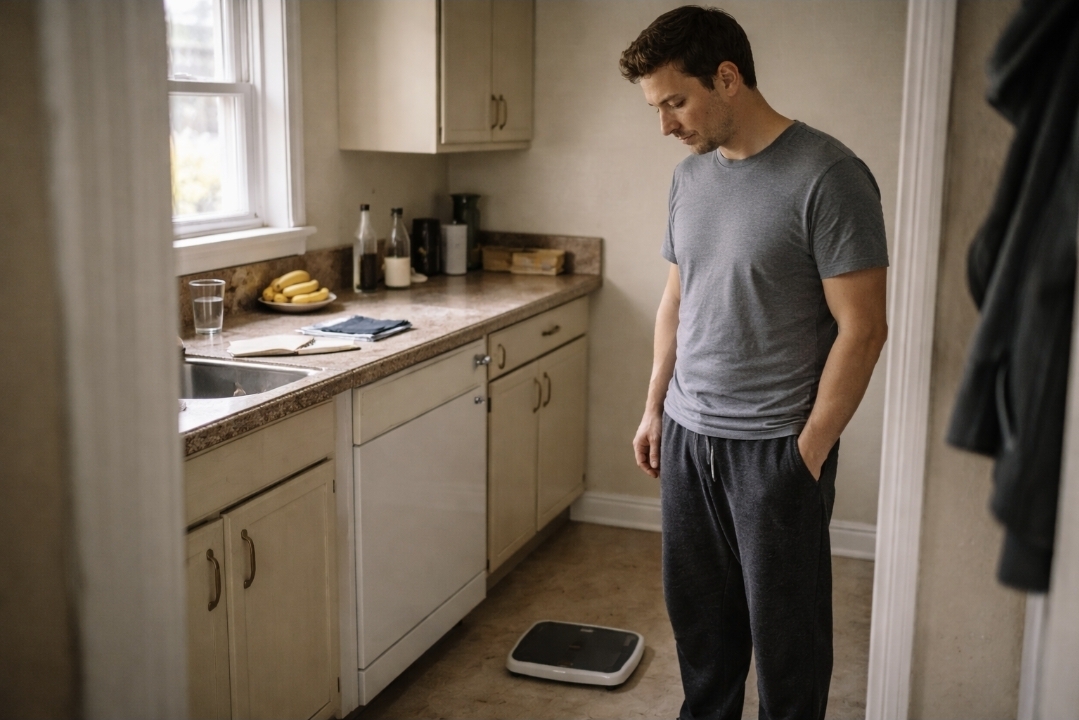
Day five. You step on the scale. Same as yesterday. Same as the day before that.
The fast is still running. Nothing has changed. But the scale has stopped and it is starting to feel like the whole thing has just stopped working.
It probably hasn’t. But the middle of a juice fast is when most people start to doubt themselves, and a scale that won’t budge on top of that is genuinely hard to deal with.
Read Juice Fasting for Weight Loss for the full picture on what moves during a fast and when.
The Scale Slows Down After the First Few Days
The opening drop happens fast. Then the scale stops dropping every morning.
Read Is Juice Fast Weight Loss Just Water? for the full breakdown of what that early drop actually is. A few flat days in the middle does not mean the fast has stopped working.
A flat scale does not mean a failed fast.
The scale almost always slows down hard once the first few days are over. Most people are not expecting it to slow down that fast.
What a Stall Actually Feels Like on Day 5 or 6
Day four, the scale reads the same as day three. That is not unusual. Day five, same number again. That is when it starts to feel wrong.
By day six you are not just checking — you are staring at it trying to make it make sense. You step on, see the same number, and spend the first ten minutes of the morning trying to work out what went wrong. Did you drink too much water last night. Was it the juice order. Is the scale broken.
Nothing went wrong. The opening drop is done and the slower part has started. But on day six of a fast, with the food thoughts already loud and the afternoons already grinding, that explanation does not help much when you are standing on the scale at 7am.
Three flat mornings in a row feel like a week. A week of flat mornings feels like the fast has simply stopped working. What the scale is showing has slowed down. Fat loss can still be happening underneath — it just does not show up every morning.
Why Three Flat Days Feels Worse Than It Is
A pound here, a pound and a half there, a clear drop every morning — that is what the first few days look like. Most people start treating that pace as normal before they have even finished day three. It is the exception, not the rule. It just comes first.
When the number stops doing that, that feels like the fast has broken. The fast feels the same. The effort is the same. The number is not.
Daily fluctuation makes this worse. Body weight moves around by a pound or two in either direction from sleep, stress, digestion, and fluid levels — regardless of what is happening to fat. Three flat mornings in a row can still be nothing more than normal daily movement while a slower loss is still happening. Small losses can still be happening while the scale sits there.
Reading one morning at a time is where the panic starts. A week tells you something. One morning tells you almost nothing.
How Many Flat Days Is Too Many
Three to seven flat days on a juice fast is not unusual. The question is not whether the scale has stopped — it always does at some point. The question is how long it has been stopped.
A week that looks dead morning by morning but shows a small drop when you compare the Monday number to the Sunday number is not a stall — it is just a slow week with normal day-to-day swings in it. The fast is still working. The scale is just not showing it yet.
Ten days of flat readings is still normal. It feels like a long time when you are checking every morning, but it usually fixes itself without you changing anything.
The number that matters is not today versus yesterday. It is this week versus last week. Look at it across a full week and most short stalls disappear.

When the Stall Is Actually a Problem
The only thing that tells you whether a stall is real is how long it has been going.
- 3–5 days: Almost certainly normal fluctuation
- 7–10 days: The pace has genuinely slowed
- 14+ days: The current setup is not moving the scale much
- 21+ days: A standstill worth taking seriously
A few quiet days usually sort themselves out. Two or three weeks with no movement at all is a different situation. Three straight weeks of the same number on a juice fast is unusual and worth taking seriously rather than blaming on normal fluctuation.
A few days means nothing. A few weeks means something. Most people call it a stall on day five — which is almost always too early.
If the scale jumps after returning to solid food, that is a different problem. Read Weight Regain After a Juice Fast.
Don’t call it too early.
Three flat mornings feel dramatic in the middle of a fast. They still do not tell you much by themselves.
Why a Flat Scale Hits Harder Mid-Fast
The scale always seems to stop at the hardest point in the fast.
The novelty is long gone. The food thoughts are arriving in waves — not deep physical hunger, just vivid persistent images of things that are not juice. The afternoons are the hardest part of the day. The fast is already more difficult than day one felt, and then the one thing that was making it feel worth it stops giving you anything back.
Same weigh-in. Same routine. Same reading again. Day after day.
The first time the scale sat still for a week on a fast was genuinely demoralising. Day five, the number unchanged for four days straight, everything feeling harder than the first fast had at that same point. The temptation was to call it proof that something had gone wrong. It hadn’t. Day seven the number dropped and the entire flat stretch looked different in retrospect — four days of normal daily movement covering a loss that was happening the whole time.
Checking every morning makes all of this harder to survive. Every small overnight swing looks like a verdict. A number that ticks up half a pound overnight feels like a catastrophe when you are already tired and food-deprived. The same swing on a normal eating day would go unnoticed.
Checking every two or three days instead of every morning gives you actual information rather than daily panic. The trend becomes clearer. The individual swings stop feeling like disasters.
You can even feel better and still hate the number. Waking up without the usual morning grogginess — which usually starts somewhere around day four — and then stepping on the scale to see the same reading again is one of the more irritating moments in a longer fast. The fast is clearly doing something. The scale just has not caught up yet.
If motivation drops during this stretch, the flat scale is almost always making it worse. On most fasts longer than three days, the two show up together.
Three flat days means nothing. Three flat weeks means something. Everything in between needs a week of mornings to read properly, not just one.
The scale going flat does not mean the fast has stopped working. It just means the easy part is done.