
How to Get More Juice From Leafy Greens
Leafy greens do not juice badly because they are poor juicing ingredients. They juice badly when you feed them into the chute as loose leaves instead of a tight, rolled-up bundle. A handful of spinach dropped into the chute folds, wraps around itself, and comes out the other side as a damp green strip with barely any juice extracted. Start with clean, trimmed leaves from how to prep produce for juicing, then pay close attention to how you load the chute.
Why Greens Are Harder to Juice
Carrots, beets, apples, cucumber, and celery have body. They hold their shape against the blades or the auger, giving the cutting mechanism something solid to press. Leafy greens have almost none of that structure. Spinach, kale, romaine, parsley, and arugula are thin and light, and a loose pile gives the machine almost nothing firm to press.
On a fast centrifugal machine, loose leaves reach the pulp catcher before the blades get much from them at all.
Softer greens and herbs make the feeding problem more obvious. Baby spinach and cilantro have so little structure that the machine barely breaks them down, while sturdier leaves with stems hold up a little better. Thinner leaves need tighter bundling and firmer produce behind them to juice properly.
Bunch Greens Tightly
Loose leaves fed one at a time spread through the chute and pass the blades too easily. A tight bundle creates a denser mass, so more of each leaf is pressed instead of passing through too loosely.
Roll or fold the leaves into a compact bundle before feeding them into the chute. Stack several leaves, roll them into a cylinder the width of the chute, and feed the roll rather than a handful. Kale and chard stems help the bundle hold together; loose baby spinach easily comes loose as you handle it, so roll it more tightly or wrap it inside a larger leaf.
Do not pack the chute too tightly. Pack the chute too full and the machine may stall or trap the bundle against the blades without turning it. Use a bundle that compresses with a little hand pressure and still feeds, not the biggest wad forced into the chute.
Alternate Greens With Hard Produce
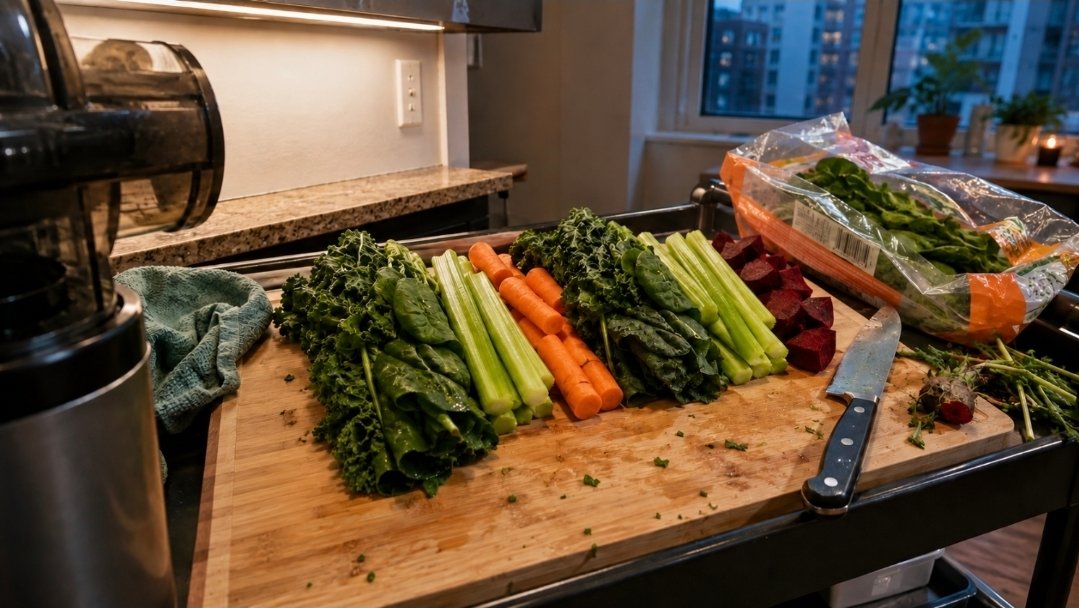
Feed a rolled bundle of kale, then a carrot, then more greens, then a celery rib. The firm pieces help push the greens through the chute instead of letting them sit above the blades.
Do not feed a full pile of greens on their own and expect a clean yield; pair each greens bundle with carrot, apple, beet, cucumber, or celery already planned for the juice session.
Alternating is not the same as feeding pieces in any order. The order is deliberate — greens, then something firm to push the leaves through, then greens again — so each bundle is cleared before the next one goes in.
Slow Down
Pushing the plunger harder seems like it should force more juice out of greens. Hard pushing does the opposite. Leaves juice better when you let the machine pull one handful down before feeding the next one into the chute.
After each greens bundle, wait until the motor returns to its normal pitch before adding the next piece. When you rush the feed, half-pressed leaves go straight to the catcher. You can hear the difference too — greens fed too fast keep the motor high instead of dropping into the lower hum you hear with firm fruits and vegetables.
Feed too quickly and you get very little juice in the glass while more leaf ends up in the pulp bin.
Check the Pulp
For leafy greens, the clearest sign is in the pulp container.
Whole, flat, bright green pieces in the catcher mean the machine pressed the leaves poorly. Duller, matted pulp means the leaves were broken down properly; a little dampness is normal.
If the whole bin is wet across carrots, celery, cucumber, and greens, the problem is wider than leafy greens; see why your juicer leaves wet pulp before reworking your greens technique.
When Your Juicer Is the Problem
Some machines still struggle with greens after you have fixed your feeding method. A centrifugal juicer depends more on firm produce to push greens through, while a cold press grinds leaves slowly through an auger and extracts more juice from them.
Consider your juicing appliance only after you have fixed the way you feed the greens. If greens are a major part of your fast and the pulp bin still holds half-juiced leaves, compare machine type and model limits in best juicer for juice fasting.
Leafy greens will never yield juice like cucumber or carrot. The goal is just to get more of that juice into the glass and less into the bin.