
Can I Drink Grapefruit Juice on a Juice Fast if I Take Medication?
Whether grapefruit belongs in your juice fast depends on the medicine you take. Some prescription and over-the-counter medicines interact with grapefruit; plenty of others have no grapefruit warning. The answer depends on the exact medicine you take.
Freshly squeezed, homemade, cold-pressed, organic, and low-sugar grapefruit juice can still interact with medication. If grapefruit is in the bottle or recipe, include it when you check the medicine information. Half a grapefruit in a green blend is not a negligible amount when medication is involved, and neither is a smaller splash added for flavor.
Drinking grapefruit juice at breakfast and taking the tablet that evening is not a dependable way around an interaction. For medicines affected by grapefruit, check whether the medicine says to avoid grapefruit instead of relying on a gap of a few hours.
Look Up Your Exact Medicine Before Adding Grapefruit
Start with the medication package or bottle.
Find the medicine name, then check the strength and formulation. The formulation can matter because different versions of a medicine may have different directions. If you need to ask a pharmacist, giving them “my cholesterol tablet” or “an allergy pill” leaves them having to identify the medicine before they can answer the grapefruit question.
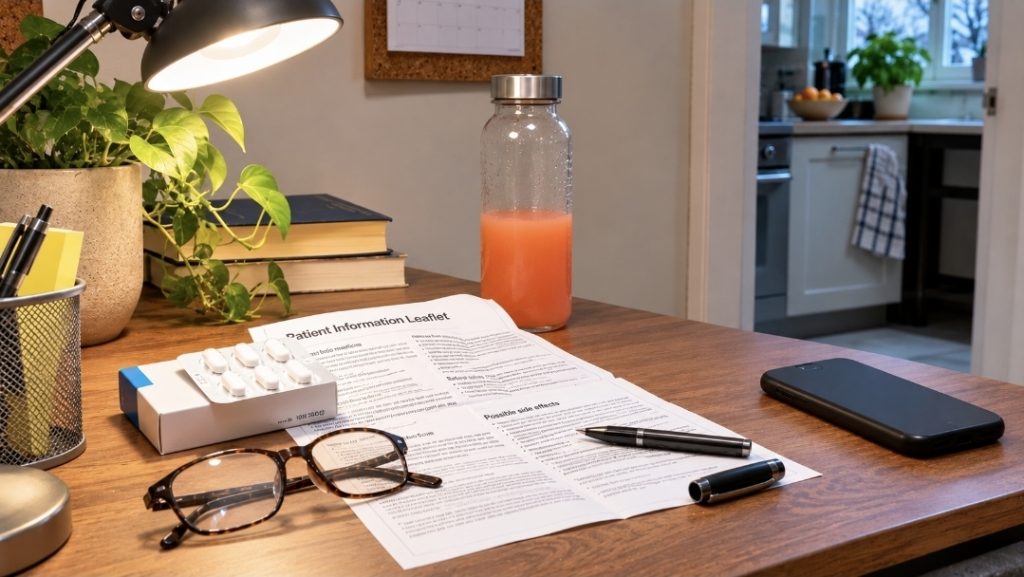
Check the prescription label, Medication Guide, or patient information leaflet supplied with the medicine. For something bought over the counter, read the Drug Facts label and any information inside the package as well. The FDA advises checking the information for the specific medicine because grapefruit affects some drugs within a category without affecting every drug in that category.
Simvastatin has a direct grapefruit warning. The DailyMed prescribing information for simvastatin says to avoid grapefruit juice while taking it. Knowing that does not tell you what to do with every other cholesterol medicine.
Check over-the-counter medicines as well. Fexofenadine, an antihistamine available without a prescription in some strengths, has fruit-juice instructions of its own. The DailyMed prescribing information for fexofenadine notes that grapefruit, orange, and apple juices may reduce its absorption and recommends taking it with water.
Grapefruit can increase the amount of some drugs reaching the bloodstream while reducing the absorption of others, so the exact medicine matters more than the category it belongs to.
Taking the Tablet Later May Not Prevent an Interaction
Mayo Clinic notes that simply taking a medicine at a different time from grapefruit is not enough in most cases where an interaction exists. There is no reliable general timing gap without knowing which medicine you take.
Many medicines are partly broken down in the small intestine by an enzyme called CYP3A4 before the drug reaches the bloodstream. Grapefruit can block some of that enzyme activity. With affected medicines, more of the drug can then reach the blood than would otherwise be expected.
The effect on intestinal CYP3A4 can persist beyond the day the grapefruit was consumed. Because the enzyme effect can persist, moving a dose to the evening or waiting until the next day may still not prevent the interaction.
Fexofenadine works differently. Grapefruit can interfere with transport proteins involved in absorption, so less of the medicine reaches the bloodstream and it may not work as well.
The FDA says the effect can differ according to the medicine, the person, and the amount of grapefruit consumed. There is no universal waiting period or serving size that can be applied to every affected medicine, so a small glass should not automatically be assumed safe.
If the grapefruit or juice instructions are unclear, ask a pharmacist to check the exact product and formulation.
Taking a smaller dose, taking an extra dose, skipping one, or moving it to another time is a medication decision, not a juice-recipe adjustment. Follow the medicine instructions or advice from the pharmacist or prescriber.
Check Every Ingredient in the Bottle
The front label alone will not tell you whether a bottled juice contains grapefruit.
A bottle can be sold as “green juice,” “100% juice,” a citrus blend, or a vegetable drink while grapefruit appears halfway down the ingredient list. A bottle covered in cucumber, celery, and leafy greens may still contain grapefruit for acidity or flavor.
When checking bottled juice labels, read the complete ingredient list. If you have bought a multi-bottle cleanse, check each blend instead of assuming the whole pack uses the same fruit. If one bottle contains grapefruit, check that blend against your medication before drinking it.
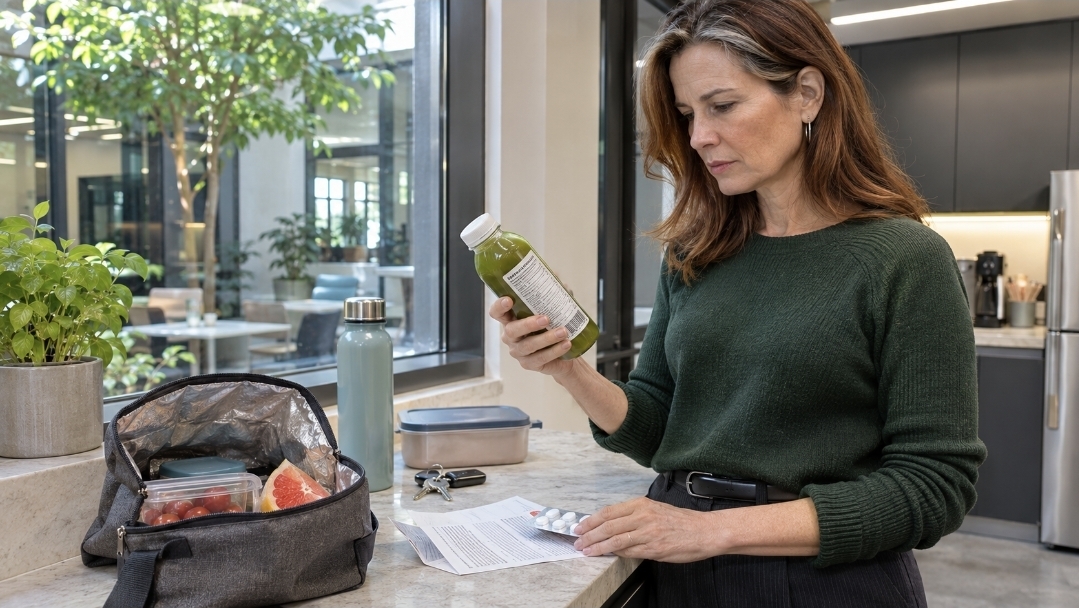
With homemade juice, you know what went through the juicer, but not every ingredient appears in the recipe name. “Ginger greens” might be mostly romaine, cucumber, and ginger with half a grapefruit added at the end.
Small amounts of grapefruit need the same medication check. There is no universal grapefruit quantity that can be declared safe across every affected medicine. A recipe using a quarter grapefruit or a small pour of grapefruit juice may contain less than a full glass, but that does not tell you whether it is compatible with your medicine. If the medicine information says to avoid grapefruit, treat that wording literally unless your pharmacist or prescriber tells you otherwise.
Check the medicine guidance for related citrus as well. The FDA specifically mentions Seville oranges, pomelos, and tangelos as fruits that might have effects similar to grapefruit when a medicine interacts with grapefruit. Ordinary sweet oranges should not be automatically put in the same category for every drug.
Whether a juice is pasteurized does not tell you whether its grapefruit content is compatible with your medication.
Choosing a Replacement Needs One More Check
If you remove grapefruit from the recipe, check the replacement before adding another fruit juice.
Read the wording carefully because two instructions that sound similar can mean different things. A direction to “take with water” tells you what should accompany the tablet. A separate grapefruit warning can apply to grapefruit consumed at another point in the day.
For a different medicine, removing grapefruit may be enough if the other ingredients carry no relevant warning. If you want to replace some of the lost volume or flavor, cucumber, celery, leafy greens, or another ingredient already in the recipe can do that. Check those ingredients against the medicine information before adding them to the replacement juice.
Even if the ingredients are compatible with your medication, planning a juice fast still requires checking whether several days on juice alone are appropriate for you.
If You Have Already Had the Juice
Stop drinking more grapefruit while you check the medicine instructions. Having already consumed grapefruit does not prove that an interaction occurred.
Check the prescription label, Medication Guide, patient information leaflet, or Drug Facts label. If the grapefruit advice is unclear, contact a pharmacist, doctor, or other clinician who can check the medicine.
Keep the commercial juice bottle, or have the homemade recipe available. “I had a green juice” gives very little information. Saying that the drink contained cucumber, spinach, ginger, and half a grapefruit and that you drank about 14 fl oz tells the pharmacist exactly what you drank and roughly how much.
Follow the medicine instructions or the clinician’s advice for your next dose. Skipping the dose, taking it late, doubling the following dose, or changing the amount because of the grapefruit can cause a dosing error in addition to the possible interaction.
You may feel completely normal after the juice. Some food–medicine interactions affect absorption or metabolism without producing an immediate sensation.
Severe or rapidly worsening symptoms need prompt medical assessment. Do not assume severe or rapidly worsening symptoms are part of fasting or label them as a detox reaction simply because they appeared during a juice fast.
Before you speak to a pharmacist or prescriber, have these details ready:
- The medicine: exact name, strength, and formulation shown on the package or bottle.
- Your dose: how much you normally take, when you last took it, and when the next dose is due.
- The juice: the complete ingredient list or homemade recipe, including the approximate amount of grapefruit if you know it.
- How much and when: roughly how much juice you drank and the time you finished it.
- Symptoms: any new or worsening symptoms and approximately when they started.