
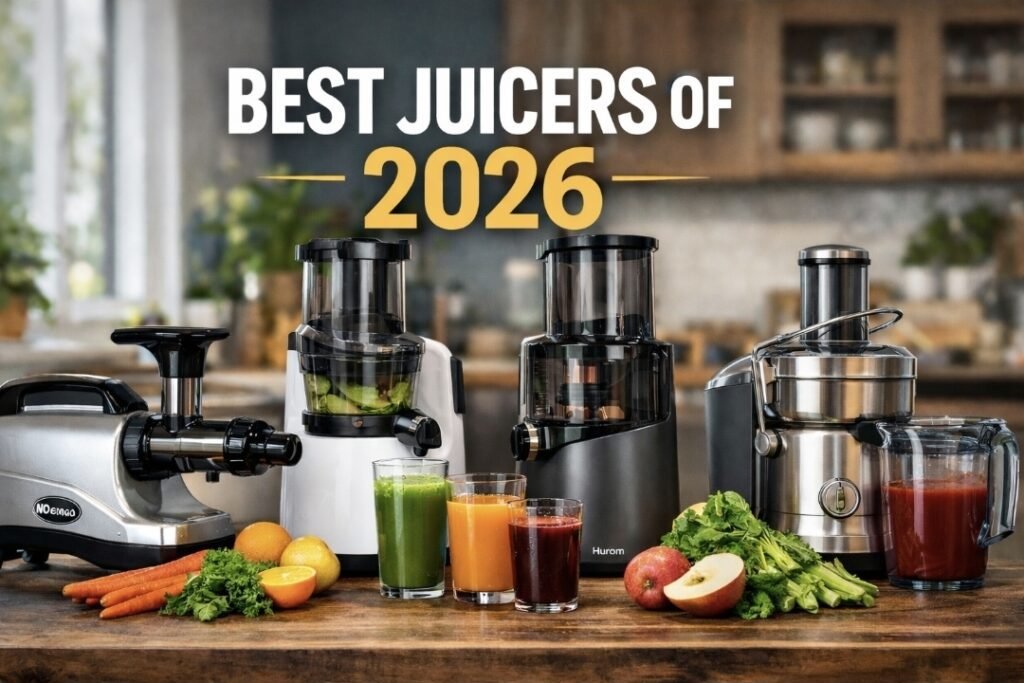
Best Juicer for Juice Fasting (2026 Beginner-to-Expert Guide)
Choosing the right juicer can make or break your juice fast.
The difference presents itself quickly. A good juicer produces higher-quality juice, extracts more nutrients, and makes the entire fasting experience easier.
A poor juicer wastes produce, creates low-quality juice, and often causes people to quit early.
If you’re serious about avoiding problems like juice fasting headaches, the quality of your juicer matters more than any other piece of equipment.
This guide shows you exactly which juicers are worth buying and which ones are not.
Quick Comparison Summary
| Juicer | Best For | Type | Price Level | Verdict | |
|---|---|---|---|---|---|
| Omega NC1000 | Best overall | Cold Press | Mid | Most reliable and best long-term investment | Check Price on Amazon |
| Nama J2 | Best convenience | Cold Press | Premium | Easiest juicer to use daily | Check Price on Amazon |
| Hurom H400 | Best easy cleaning | Cold Press | Premium | Excellent performance with easier cleanup | Check Price on Amazon |
| Breville Juice Fountain Plus | Best beginner budget | Centrifugal | Low | Good starter, but weaker long-term choice | Check Price on Amazon |
| AMZCHEF Slow Juicer | Best budget cold press | Cold Press | Low | Best value entry-level cold press | Check Price on Amazon |
Omega NC1000 — Best Overall for Juice Fasting
Who it’s for:
This is for anyone serious about juice fasting. If you plan to do repeated fasts, longer fasts, or want maximum reliability, this is the safest choice.
Who should NOT buy it:
If you only plan to juice occasionally and you’re allergic to any cleaning at all, you may find a cold press routine annoying.
If your priority is speed above everything, a centrifugal juicer will feel faster, even if the juice quality is clearly lower.
Real-world ownership experience:
The Omega NC1000 earns its reputation the boring way: it just keeps working.
Day after day, it produces consistent juice with fewer “surprises” than cheaper machines.
That matters during fasting because you’re not making one juice. You’re making multiple juices every day, often for days in a row.
With the Omega, you can settle into a routine and stop thinking about the machine.
Daily juice fasting performance:
The Omega is excellent for the typical fasting rotation: celery, cucumber, leafy greens, carrots, apples, lemon, ginger.
It handles high-water produce without turning everything into foam, and it handles fibrous produce without constantly choking.
If you’re fasting and trying to keep your energy stable, consistency beats novelty.
Equipment drama is one of the easiest ways to create extra friction, extra stress, and a higher chance of quitting early.
Stress plus lower intake is not a great combination for avoiding headaches during a juice fast.
How it handles celery, leafy greens, and carrots:
Celery is the make-or-break ingredient for many juicers. It’s stringy, it wraps, and it exposes weak motors.
The NC1000 handles celery reliably as long as you cut stalks into manageable lengths and feed at a steady pace.
Leafy greens perform well, especially when you alternate greens with a “push” ingredient like cucumber or apple.
Carrots are not a problem. The motor has the torque to chew through them without sounding like it’s dying.
Juice yield quality:
This is where the Omega separates itself from most budget juicers.
The pulp comes out notably drier, which means you’re paying for less waste and more actual juice.
During a fast, yield is money. If a cheaper juicer wastes even a small amount per batch, it adds up fast over a week.
Better yield also reduces the “I need more produce than I expected” problem that kills motivation.
There’s a second benefit: juice tends to be less foamy and stays fresher longer in the fridge.
That’s useful when you’re prepping ahead and trying to avoid energy dips that can contribute to fatigue.
Cleaning reality (what owners actually experience):
Cleaning is not hard, but it is real.
Once you’ve done it a few times, it’s typically a 5–8 minute job if you rinse immediately after juicing.
If you leave it to dry, you’ll pay for it later. Dried pulp turns a quick rinse into a scrub.
The practical move is simple: rinse parts right away, do a quick brush pass, and air dry.
Motor durability and expected lifespan:
This is the long-term value play.
Many owners use an Omega-style masticating platform for 8–12+ years.
That’s not hype. It’s what you see when a machine is built for torque and daily use.
Warranty and parts replacement reality:
Omega is one of the more established names in the category, which matters when you need an accessory, a replacement screen, or a small part years later.
In real life, that translates to less “my juicer is dead because of one plastic piece” frustration.
Noise comparison:
It’s quiet for a juicer. You can run it in the morning without it feeling like a construction tool.
Compared to a centrifugal machine like the Breville, the sound is less sharp and less intrusive.
Comparison to other models in this article:
Against the Nama J2, the Omega is less “hands-free,” but just as dependable and often easier to justify financially.
Against the Hurom H400, the Omega usually wins on classic celery-and-greens toughness, while Hurom wins on cleaning simplicity.
Against the AMZCHEF, the Omega wins on longevity and consistency under heavy daily use.
Cost-per-year ownership logic:
If you use it for 8–10 years, it becomes cheap per year. A budget machine that breaks in 18–24 months is expensive per year, even if the price tag is lower.
Add produce savings from higher yield, and the math becomes even more one-sided in favor of the Omega.
Real ownership annoyances nobody talks about:
The feed chute is narrower than modern premium juicers, which means more prep cutting. During a long fast, this adds a few extra minutes per day.
Celery fibers can occasionally wrap around the auger if you feed long, uncut stalks too quickly. This isn’t a failure — it’s normal cold press behavior — but it reinforces the importance of proper prep.
The flip side is that these minor annoyances rarely turn into serious reliability problems. The Omega trades convenience for durability.
What happens after 6–12 months of real use:
This is where the Omega separates itself from most competitors.
Many machines feel great in the first few weeks. The Omega still feels normal years later.
The motor remains consistent, yield stays strong, and performance does not gradually degrade the way budget machines often do.
This long-term consistency is the real reason experienced fasters trust it.
Final verdict:
If you want one juicer that won’t limit your fasting results, buy the Omega NC1000.
It’s the best blend of yield, reliability, and long-term ownership value.
Nama J2 — Best Premium Convenience Juicer
Who it’s for:
This is for people who want the easiest daily juicing experience possible.
If you’re busy, easily distracted, or you know you’ll quit if the process feels like work, the J2 is the convenience king.
Who should NOT buy it:
If budget is tight, the price can feel painful.
If you already enjoy a hands-on juicing routine and you don’t mind feeding produce slowly, you may not get enough extra benefit to justify the premium.
If you hate prep work, be honest about that too.
The hopper is hands-free, but you still need to wash produce and cut fibrous ingredients to get the best results.
Real-world daily fasting experience:
The J2 changes how juicing feels during a fast.
You can prep a bowl of produce, load the hopper, and let it work while you do something else.
That sounds minor, but on day 2 or day 3, minor is the whole game.
If you’re trying to keep symptoms down and avoid juice fasting headaches, consistency matters more than “perfect” juice science.
The J2 is built to remove the biggest consistency killer: standing there feeding a chute over and over.
Self-feeding hopper reality:
When it helps, it feels effortless.
You load it, it pulls ingredients down, and you’re not doing the constant push-and-wait loop.
When it clogs, it’s usually because the hopper got over-packed with fibrous produce at the top.
The practical fix is simple: mix your load.
Combine celery and greens with watery produce (cucumber) or a “push” ingredient (apple/carrot) instead of dumping a full hopper of long celery at once.
Celery performance (speed, pulp dryness, prep):
Celery is the stress test for any juicer, and the J2 does it well when you use good technique.
Cut stalks into shorter lengths and don’t feed tangled bunches whole.
With normal prep, it runs at a steady pace and produces pulp that’s reasonably dry for celery-heavy blends.
Compared to the Omega, the J2 is slightly more “set it and watch it,” but the Omega can feel more forgiving when you get lazy with fibrous loads.
Leafy greens performance:
Greens do well, especially in blended juices.
Pure leafy greens can slow any cold press juicer, so it’s smart to alternate greens with cucumber, celery, or apple.
In real life, a greens blend is less about “can it juice greens” and more about “does it keep moving without you babysitting it.”
The J2 generally does, as long as your mix isn’t 90% greens with no push ingredient.
Carrots and hard produce performance:
Carrots run cleanly and the motor feels confident under load.
Large carrots still benefit from being cut down, not because the J2 can’t handle them, but because long-term durability improves when you reduce shock loads.
Hard produce like apples and beets can be handled, but don’t treat any cold press machine like a centrifugal “shredder.”
Steady feeding keeps the machine happy and keeps the juice texture more consistent.
Juice quality and yield:
Juice quality is premium-level.
You’ll typically see less foam than a centrifugal and slower separation in the glass.
Yield is excellent for a cold press machine, and that matters when you’re buying produce daily.
Better yield makes it easier to hit your target intake without feeling like your grocery bill is exploding.
More consistent intake supports steadier energy and can help reduce patterns that often show up when people under-juice without noticing.
Cleaning reality (time, frustrations, what needs brushing):
Cleaning is easier than many older cold press machines, but it isn’t “no-clean.”
If you rinse immediately after juicing, most people can clean it in about 5–8 minutes.
The parts that usually need brushing are the areas where fine pulp collects near the outlet and any mesh-like surfaces that trap fibers.
The main frustration is what happens when you don’t rinse right away.
Dried pulp turns quick rinsing into scrubbing, and scrubbing on day 3 of a fast is how people start skipping juices.
Maintenance and Parts Reality
Expect routine wear items over time, not constant failures.
Brushes eventually fray and get less effective, especially if you scrub dried pulp often.
Silicone seals can loosen or flatten after years of daily washing.
Warranty expectations are typically stronger with premium brands, but warranty won’t cover “I abused it with a full hopper of uncut celery every day.”
If you want long life, treat it like a kitchen appliance, not a workshop tool.
Noise level compared to Omega:
The J2 is quiet and smooth, similar to the Omega in overall loudness.
The sound profile tends to feel more “appliance hum” than “mechanical grind.”
Compared to the Breville, it’s not even the same universe.
Durability and parts replacement reality:
As a premium machine, the expectation is strong durability under frequent use.
Long-term ownership depends on basic care: reasonable prep, steady feeding, and prompt cleaning.
Premium brands generally make parts availability and support easier than generic budget options, which matters if you keep a juicer for years.
Realistically, any juicer can need a gasket, a container, or a small replacement part over time.
Buying premium is partly buying the likelihood that you can actually get those parts when you need them.
Ownership frustrations (honest but fair):
The price is the obvious pain point.
Another frustration is that “hands-free” can tempt people to overload the hopper, which creates clogs and annoyance.
You still need a basic rhythm: load smart, don’t cram fibrous piles, and keep a mixed ingredient flow.
If you want a machine you can abuse with zero technique, the Omega’s traditional feed style can be more forgiving.
Long-term ownership expectation:
If you’re the kind of person who will juice regularly, the J2 can be a long-term daily tool.
If you’re the kind of person who will juice for one week and then stop for months, it’s too much money for too little use.
Be honest about your habits before you buy premium.
Long-term ownership reality (what owners notice after months):
The biggest difference is behavioral, not technical.
People juice more consistently because the process feels easier.
The hopper reduces the mental resistance that builds during longer fasts.
Instead of thinking “I don’t feel like juicing,” you load ingredients and let the machine run.
This improves compliance, which directly improves fasting stability.
Common complaints:
The most common mistake is overloading the hopper with dense celery.
This can slow the machine and create temporary clogs.
Once users learn to mix ingredients properly, this largely disappears.
Final verdict:
If you want the easiest daily juicing experience and you can afford it, buy the Nama J2.
It’s the best choice for reducing friction, staying consistent, and making fasting feel doable day after day.
Hurom H400 — Best Easy Cleaning Premium Juicer
Who it’s for:
This is for people who want premium cold press juice but hate the classic strainer-cleaning routine.
If your biggest risk is quitting because cleanup feels like a chore, the H400 exists for you.
Who should NOT buy it:
If you want the most “tank-like” workhorse for heavy celery use, the Omega NC1000 is still the safer bet.
If you’re trying to spend the minimum possible, premium cleaning features won’t make sense.
If you already don’t mind cleaning and you rinse immediately every time, you may be paying extra for convenience you don’t actually need.
Daily fasting usability reality:
During a juice fast, your patience is lower than normal.
That’s not weakness. It’s physiology and routine pressure.
When a juicer feels fussy, people delay juicing, then they under-consume, then symptoms stack.
That’s how many people end up with headaches during juice fasting even when they started motivated.
The H400’s main job is to make daily juicing feel less like a project.
It generally succeeds, especially for people who hate small fiddly parts.
Strainer-free cleaning reality (true time and limitations):
Hurom’s strainer-free design can reduce the “scrub the mesh forever” problem.
In real life, that often means a faster rinse cycle, usually around 3–6 minutes if you clean immediately.
The limitation is that “strainer-free” does not mean “no brushing.”
Fibers still collect in corners and outlets, especially after celery and greens.
You still need a quick brush pass on the areas that catch stringy pulp.
The difference is that you’re not fighting a dense mesh screen that traps pulp like Velcro.
Celery performance:
Celery runs well when you treat it properly.
Cut it down and avoid feeding long tangled bunches continuously.
For typical fasting blends (celery + cucumber + greens), it performs smoothly and produces clean juice.
Versus the Omega, it can be slightly less forgiving if you try to shove pure celery through without mixing.
Leafy greens performance:
Greens do well, especially with a mixed ingredient flow.
If you want to juice mostly greens, add a push ingredient like cucumber or apple.
Carrot and hard produce performance:
Carrots are handled confidently with normal prep.
Cut larger carrots into smaller sections to keep motor load steady.
Juice quality vs Omega and Nama:
Juice quality is premium-level, with low foam and good stability.
Versus Omega, you may see slightly different pulp dryness depending on your recipe, but both are firmly in the high-quality cold press category.
Versus Nama J2, the difference is less about juice and more about experience.
Nama wins on hands-free loading. Hurom wins on simpler cleanup and fewer “mesh scrubbing” moments.
Maintenance and Parts Reality
The H400 reduces cleaning friction, but it’s still a juicer with seals, brushes, and wash cycles.
Brushes wear. That’s normal, and it’s cheaper to replace a brush than to “power through” with a worn one and turn every clean into a longer fight.
Seals can loosen gradually with daily hot water use and repeated assembly.
Warranty support is typically better than budget brands, but it still expects normal use and reasonable prep.
Parts replacement is a real-world factor with any long-term appliance, and established brands are usually easier to deal with when you need a specific piece.
Noise and vibration reality:
The H400 is quiet for a juicer.
It’s closer to the Omega and Nama in sound profile than anything centrifugal.
Durability and expected lifespan:
It’s a premium appliance and should hold up well with frequent use.
If you’re doing heavy daily fasting multiple times per year and you want maximum lifespan certainty, the Omega remains the safer long-term reputation pick.
Parts replacement reality:
Hurom is an established brand, which generally improves your odds of getting parts and support later.
A missing seal or cracked container can stop you just as effectively as a motor issue.
Real frustrations owners experience:
The biggest frustration is expectation mismatch.
“Easy cleaning” means less annoying cleaning, not zero effort.
Another frustration is technique: if you run lots of pure celery or dense greens without mixing, you can create more fiber build-up and slower flow.
Real-world juice texture and drinking experience:
The juice produced is smooth, dense, and stable.
Separation happens slowly, and flavor remains consistent for longer storage periods.
This makes batch juicing realistic, which reduces daily workload during fasting.
Long-term ownership complaints:
Most complaints are expectation-related.
Cleaning is easier, but not effortless.
Once owners adjust expectations, satisfaction is generally high.
Final verdict:
If cleaning friction is what typically makes you quit, the Hurom H400 is the premium choice that keeps you consistent.
Consistency is what makes fasting feel smoother, and it’s a big factor in reducing juice cleanse headaches caused by under-juicing and poor routine.
Breville Juice Fountain Plus — Best Beginner Budget Option
Who it’s for:
This is for beginners who want to try juicing or a short juice fast without spending much money.
If you’re not sure you’ll stick with juice fasting, a lower-cost centrifugal can be a reasonable “test” machine.
Who should NOT buy it:
If you plan to do multi-day fasts regularly, rely heavily on celery and leafy greens, or you want the best yield for your produce budget, you should skip centrifugal and go cold press.
If noise is a dealbreaker, this will annoy you.
Daily juice fasting experience:
This is the classic centrifugal experience: it’s fast, loud, and feels powerful.
You can crank out juice quickly, which is appealing on day 1 of a fast when motivation is high.
The trade-off is texture and stability.
The juice is often foamier, and separation happens quickly in the glass.
Foam and separation reality:
Foam is not just cosmetic.
It changes mouthfeel, and it can make vegetable-heavy juice less pleasant to drink when you’re already not eating.
Separation is also faster, which means juice can taste “thinner” and less fresh even within a short window.
Oxidation and storage limitations:
Centrifugal juice generally oxidises faster because of the high-speed process and increased air mixing.
Stored juice can lose that clean taste sooner, and the flavor shifts faster.
If you’re trying to batch juice to reduce daily effort, this becomes a problem.
Batch juicing is one of the easiest ways to stay consistent and reduce the odds of lethargy during a juice fast.
Why serious fasters upgrade:
People upgrade for yield, juice stability, and daily livability.
Low yield means more produce per day.
Foam and fast separation make juice less enjoyable, which can quietly reduce intake.
Maintenance and Parts Reality
The mesh basket is the part that determines whether cleaning feels easy or miserable.
Rinse immediately and it’s fine.
Let it dry and you’ll be scrubbing a screen that behaves like it’s designed to trap pulp forever.
Brushes wear and get lost. Replace them when cleaning starts taking longer than it should.
Warranty expectations are normal for a mainstream appliance, but heavy daily use is not what most beginners do with a centrifugal.
Celery performance:
Celery is not the Breville’s strength.
You’ll often see wetter pulp and lower yield on celery compared with a cold press juicer.
Leafy greens performance:
Leafy greens are generally a weak point for centrifugals.
Carrots and hard produce performance:
This is where centrifugals shine. Carrots and apples juice quickly.
What usually happens after the first fast:
Many users upgrade.
The Breville works well enough to prove that juice fasting is possible.
But the yield loss, foam, and cleaning friction become more noticeable with daily use.
This is why centrifugal machines are often entry points, not long-term solutions.
Final verdict:
If you need a low-cost entry point and you value speed over yield, the Breville can work.
If you already know you’re serious about fasting, skip it and buy a cold press juicer instead.
AMZCHEF Slow Juicer — Best Budget Cold Press Juicer
Who SHOULD buy it:
This is for anyone who wants the core benefits of cold press juicing without paying premium pricing.
If your budget is tight but you’re still serious about juice fasting, AMZCHEF is often the smartest “start correctly” choice.
It gets you out of the centrifugal trap: low yield, foamy juice, and fast separation that makes fasting harder than it needs to be.
Who should NOT buy it:
If you’re planning frequent long fasts every year and you know you’ll be juicing heavily for years, the Omega NC1000 is the safer bet.
If you’re the kind of person who doesn’t want to cut produce, doesn’t want to learn feeding technique, and gets frustrated fast, a budget machine can feel like work.
If you want the smoothest “premium appliance” experience, you’ll notice the difference with Nama or Hurom.
Daily juice fasting ownership experience:
With AMZCHEF, the first week usually feels great.
You get clean cold press juice, it’s quieter than a centrifugal, and you’ll notice less foam in the glass.
Then reality kicks in: budget cold press machines are less forgiving when you get sloppy.
On a fast, you’ll have days where you’re tired and you rush.
Rushing is where AMZCHEF punishes you.
If you cut properly, feed steadily, and rinse immediately, it can be a reliable daily partner through a fast.
If you throw long celery in whole and walk away, you’re more likely to experience slowdown, wrapping, and the “why is this stuck again” moment.
That’s not a dealbreaker. It’s a trade-off that comes with paying less.
Celery performance (prep required, pulp dryness, clog risk):
Celery is the ingredient that exposes every weakness in a juicer.
The AMZCHEF can handle celery well, but it requires prep and rhythm.
Cut stalks into shorter lengths.
Feed at a steady pace instead of dumping a full bundle in at once.
For celery-heavy juices, mix celery with cucumber or apple to keep the auger moving and reduce fiber build-up.
Pulp dryness is generally good for the price, but it’s not consistently as dry as the Omega on celery-only runs.
That’s the main yield gap you’ll notice: you may need slightly more celery to hit the same volume.
Clog risk is mostly self-inflicted.
It rises when you run pure celery nonstop or you feed long tangled pieces without a push ingredient.
Leafy greens performance:
Leafy greens are fine in blends and generally produce respectable juice.
Where it slows down is when you try to run pure greens continuously.
That’s not unique to AMZCHEF, but premium machines tend to handle those loads more smoothly.
The realistic approach for fasting is blended greens: spinach/romaine/kale with cucumber, celery, or apple.
That mix is easier on the machine and more pleasant to drink consistently.
Carrot and hard produce performance:
Carrots and hard produce can be handled, but prep matters.
Cut large carrots into smaller chunks and avoid repeatedly shocking the motor with huge hard pieces.
If you treat it gently, it will do the job.
If you try to brute-force beets and carrots without prep, you increase the chance of early wear or stalling.
Cleaning reality (actual time, brush use, staining, frustrations):
Cleaning is the real “cost” of any juicer during a fast, and AMZCHEF is no different.
If you rinse immediately, cleaning is often 6–10 minutes.
The areas that usually need brush work are the pulp outlet, the fine grooves where fiber sticks, and any mesh-like surfaces.
Budget plastics tend to show stains over time, especially with carrots, turmeric, and beet-heavy juices.
Staining doesn’t affect function, but some owners hate how it looks.
The biggest frustration is procrastination.
If you let pulp dry, cleaning time jumps quickly and the whole process becomes annoying.
On a fast, annoyance becomes avoidance.
Avoidance becomes missed juice.
Missed juice becomes lower mineral intake and more risk of feeling off, including juice cleanse headaches.
Noise reality vs premium machines:
It’s generally quieter than a centrifugal and livable for morning use.
Compared to premium cold press machines, it can sound a bit more “plastic and mechanical,” especially under heavy load.
It’s not unbearable. It’s just less refined.
Durability reality (what fails first, expected lifespan range):
This is the honesty section budget brands don’t emphasize.
With heavy daily use, the most common failure points tend to be wear on plastic parts, seals loosening, and occasional cracking or fatigue on components that get assembled and washed constantly.
Motors can last, but they’re less predictable over a multi-year horizon than an Omega-style workhorse.
A realistic lifespan range under heavy fasting-style use is often 1–4 years, depending on care, load, and luck.
That sounds harsh, but it’s also why the price is lower.
If you use it moderately and treat it well, you can push past that.
If you abuse it daily with poor prep, you can shorten it.
Maintenance and Parts Reality
Brushes wear and eventually stop cleaning efficiently.
Seals can loosen with repeated hot water washing and constant disassembly.
Expect occasional small maintenance: replacing a brush, keeping parts clean so they don’t warp, and checking seals for leaks.
Warranty coverage is usually shorter and more limited than premium brands.
Parts replacement can be the biggest long-term question with budget machines.
You might find replacement parts easily now, then struggle later if the exact model changes.
If you hate downtime during a fast, this is why upgrading to Omega makes sense for long-term fasters.
Comparison vs Omega, Nama, Hurom:
Versus Omega NC1000: Omega wins on longevity, celery toughness, and “forgiving” performance when your technique isn’t perfect.
AMZCHEF wins on upfront cost.
Versus Nama J2: Nama wins on convenience and a smoother daily experience.
AMZCHEF wins if you want cold press benefits without paying premium prices.
Versus Hurom H400: Hurom wins on cleaning simplicity and premium feel.
AMZCHEF wins if you want functional cold press juice and you’re willing to do the normal cleaning work.
Long-term ownership value logic:
The AMZCHEF makes sense when it prevents you from buying the wrong type of juicer first.
If your alternative is a centrifugal, AMZCHEF often saves money over time through better yield and better juice stability.
If it lasts you two years and supports multiple fasts, it may already have paid for itself in reduced produce waste compared to a low-yield machine.
If you fast regularly for years, the long-term move is usually to start here or skip straight to Omega.
Long-term ownership honesty:
The AMZCHEF delivers excellent value, but it rewards careful use.
Owners who prep correctly and clean immediately usually have good experiences.
Owners who rush and overload it experience more friction.
This difference is not random. It reflects the trade-off between price and durability.
Used correctly, it can support multiple successful fasts before upgrade becomes necessary.
Clear, decisive verdict:
If you want cold press performance under a tight budget, buy the AMZCHEF and commit to basic technique.
If you know you’ll be fasting long-term and you want the least drama over years, buy the Omega instead.
How to Choose a Juicer for Juice Fasting
Most buyer guides avoid the real truth: the best juicer is the one you will actually use every day.
During a fast, you don’t get to “skip” juicing without consequences.
Skipped juice often becomes low minerals, low calories, and unstable energy, which is how people drift into juice cleanse headaches and feel wrecked by day 2–3.
Cold Press vs Centrifugal (deep explanation)
Centrifugal juicers use a fast spinning blade to shred produce and fling juice out through a mesh basket.
They’re quick and they feel powerful, which is why beginners often buy them first.
The downside is what you live with daily: louder noise, more foam, faster separation, and typically weaker yield on fibrous ingredients like celery and leafy greens.
Cold press (masticating) juicers crush and press ingredients slowly.
They usually produce less foam, more stable juice, and better yield in the exact recipes juice fasters use most.
If you’re fasting, you care about two things more than “speed”: consistency and volume.
A fast juicer that makes juice you don’t want to drink on day 3 is not a “good” juicer for fasting.
A slower machine that produces clean, stable juice and doesn’t make you dread the routine is usually the better fasting tool.
Juice Yield and Produce Cost Savings
Yield is where money quietly disappears.
If you’re juicing daily, small differences become big numbers.
A lower-yield juicer forces you to buy more produce for the same volume of juice.
That’s not theory. You feel it at the checkout.
Real-world produce cost example:
Let’s say your fasting day produce cost is roughly $20–$35 depending on your ingredient mix and how much juice you drink.
If your juicer wastes an extra 10–15% produce (wetter pulp, lower extraction), that can be $2–$5 per day in waste.
Over a 7-day fast, that’s around $14–$35 of extra spend for the exact same intake.
Over three fasts in a year, you’re looking at $40–$100+ of “invisible cost.”
That’s why serious fasters stop obsessing over the juicer price tag and start caring about cost-per-week of produce.
Better yield also makes it easier to hit your target volume and keep energy steadier, which can reduce juice fasting fatigue patterns caused by under-juicing.
Cleaning Reality (what owners discover)
Cleaning is not hard, but it is frequent.
The “best” machine on paper becomes useless if you hate cleaning it.
Realistic daily cleaning routine example:
Disassemble, quick rinse, brush the fiber-catching areas, rinse again, air dry.
Done immediately, it’s often 5–10 minutes.
Done later, it can turn into 15–25 minutes and a bad mood.
That bad mood matters because fasting already tests your patience.
When cleaning becomes the thing you avoid, you delay juicing.
Delayed juicing turns into inconsistent intake, and inconsistent intake is a common pathway into headaches during juice fasting.
If you know you’re sensitive to friction, prioritize either convenience (Nama) or cleaning simplicity (Hurom).
If you’re fine with routine and you rinse immediately, a workhorse like Omega is easy to live with.
Durability and Motor Lifespan
Daily fasting use is not casual juicing.
Running celery, greens, and carrots repeatedly stresses motors and internal parts.
Cold press motors are built for torque, which is why they generally handle fibrous produce better over time.
Centrifugal motors are built for speed and can be fine for occasional use, but heavy daily juicing is harder on them.
Durability also affects your stress level during a fast.
A stalling or overheating juicer is an avoidable problem.
When you’re already adapting physiologically, equipment frustration can amplify discomfort and increase the odds of headaches during a juice fast.
Ownership reality after 30 days of repeated fasting-style juicing:
Most people stop caring about “features” and start caring about reliability.
They want a machine that turns on, runs smoothly, and doesn’t demand constant attention.
If you’re that person, Omega becomes the obvious long-term play.
Noise and Daily Living Reality
Noise matters more than people admit.
Juicing early in the morning on a centrifugal can feel like using power tools in your kitchen.
That’s fine once. It gets old fast when it’s daily.
Cold press machines are typically quieter and less harsh.
Noise and lifestyle example:
If you live with other people, have kids sleeping, or you prefer calm mornings during a fast, the sound difference is not a luxury.
It’s the difference between “I’ll juice now” and “I’ll do it later.”
Later can become skipped.
Skipped can become fatigue and headaches.
Oxidation and Juice Storage Quality
During a fast, many people prefer batch juicing to reduce daily work and decision fatigue.
Storage quality matters here.
Cold press juice generally holds up better in the fridge, with less foam and slower separation.
Storage and oxidation example:
If you juice in the morning and drink a portion later, cold press juice tends to stay more pleasant.
With centrifugal juice, the texture and flavor can shift quickly, especially with greens.
That can make you less likely to drink the full amount you planned.
Less intake often shows up as low energy and the “I feel off” sensation that can feed into fatigue during a juice fast.
Beginner Mistake: Buying Cheap First
The most common path looks like this: buy a cheap centrifugal because it’s “good enough,” use it for a short period, then upgrade after realizing yield and juice stability matter.
That means you paid twice.
If you know you want to juice fast, the smarter approach is to start with a cold press machine that matches your budget.
That usually means AMZCHEF as the lowest-cost cold press entry point or Omega as the long-term workhorse.
If you’re truly unsure and only want to “test the idea,” the Breville can be fine.
Just be honest about what you’re buying: speed and low cost, not optimal fasting performance.
Celery-heavy fasting example vs fruit-heavy fasting example
If your fasting plan is celery-heavy and green-heavy, you need torque and fiber handling.
That favors Omega, Nama, Hurom, and AMZCHEF over centrifugals.
If your plan is more fruit-heavy (apples, oranges, pineapple) and you’re not relying on stringy greens daily, the Breville can feel “good enough” for a short experiment.
Serious fasters usually shift toward vegetable-heavy blends for steadier energy, and that’s where cold press becomes the better tool.
Why Serious Juice Fasters Choose Cold Press
Serious fasters care about three things: yield, reliability, and routine.
Cold press wins on yield for fibrous produce, tends to win on daily livability, and supports consistency.
Consistency is the real secret to reducing early fast problems like juice fasting headaches and the drained feeling that appears when intake slips.
Cold press doesn’t make fasting “easy.”
It removes avoidable friction so the fast is about your body adapting, not your equipment failing.
How to Choose the Right Juicer in 30 Seconds
If budget under $200 → choose AMZCHEF
If serious long-term fasting → choose Omega
If convenience priority → choose Nama
If easiest cleaning priority → choose Hurom
If unsure and beginner → choose Breville or AMZCHEF
Reality Check: You Don’t Need the Most Expensive Juicer
You don’t need a premium juicer to do a successful juice fast.
You need a juicer that matches your habits and your tolerance for routine.
If you’re testing whether you even like juicing, the Breville can be a fair entry point.
If you’re committed but money matters, a budget cold press like the AMZCHEF is often the smartest start.
Premium juicers make sense when convenience is the difference between finishing your fast and quitting.
If You Only Buy One Juicer, Buy This
Buy the Omega NC1000.
It combines high yield, reliable celery performance, and long lifespan without requiring premium pricing.
Best Juicer Based on Your Situation
Best for beginners (lowest commitment): Breville Juice Fountain Plus
Best long-term investment (fasting workhorse): Omega NC1000
Best budget cold press (best value): AMZCHEF Slow Juicer
Best premium (best overall experience): Hurom H400
Best convenience (least effort daily): Nama J2
Frequently Asked Questions
Is a cold press juicer really necessary for juice fasting?
No, but it makes fasting easier. Better yield, less foam, and more stable juice improve consistency.
How long does juice last in the fridge?
Cold press juice typically stays fresh 24–48 hours. Centrifugal juice declines faster.
Is an expensive juicer worth it?
For serious fasters, yes. Higher yield and durability reduce long-term cost and frustration.
What is the best juicer for beginners?
AMZCHEF offers the best balance between affordability and proper cold press performance.